Book Tee Time
Western Lakes New Irrigation System

New Irrigation System Installation

Scheduled Fall of 2026

Back in 1962, during the construction of Western Lakes, our initial single row irrigation system was installed. Some updates were made in 1977 and 2009, but most of the system remains original. These systems were only built to last about 25 years, therefore 64 years later, Western Lakes is excited to announce we are scheduled to install a new irrigation system this Fall, with a projected completion around Thanksgiving. This upgrade will take our golf course to the next level and provide the following benefits to both Western Lakes and our guests for decades to come!

The plan is to work on each hole in sections to minimize any interruption. It will be exciting to see the installation of this new system, as it is not something most golfers get the opportunity to see in progress. We would like to thank every guest in advance for their understanding during this process, as there may be some day-to-day temporary changes to the golf course during the week. We will work hard to communicate and minimize these disruptions as best as possible while working with the weather and contractor timelines.

Paul Towler – Golf Course Superintendent
Garrett Mack, PGA – Director of Golf Operations
Greg & Paula Essig – Owners
Jason & Lauren Hoelz – General Manager & Minority Owners
Ensure more consistent playing conditions

The new system will provide greater control over where and how much water is applied, promoting healthier turfgrass and greatly reducing isolated wet and dry spots.
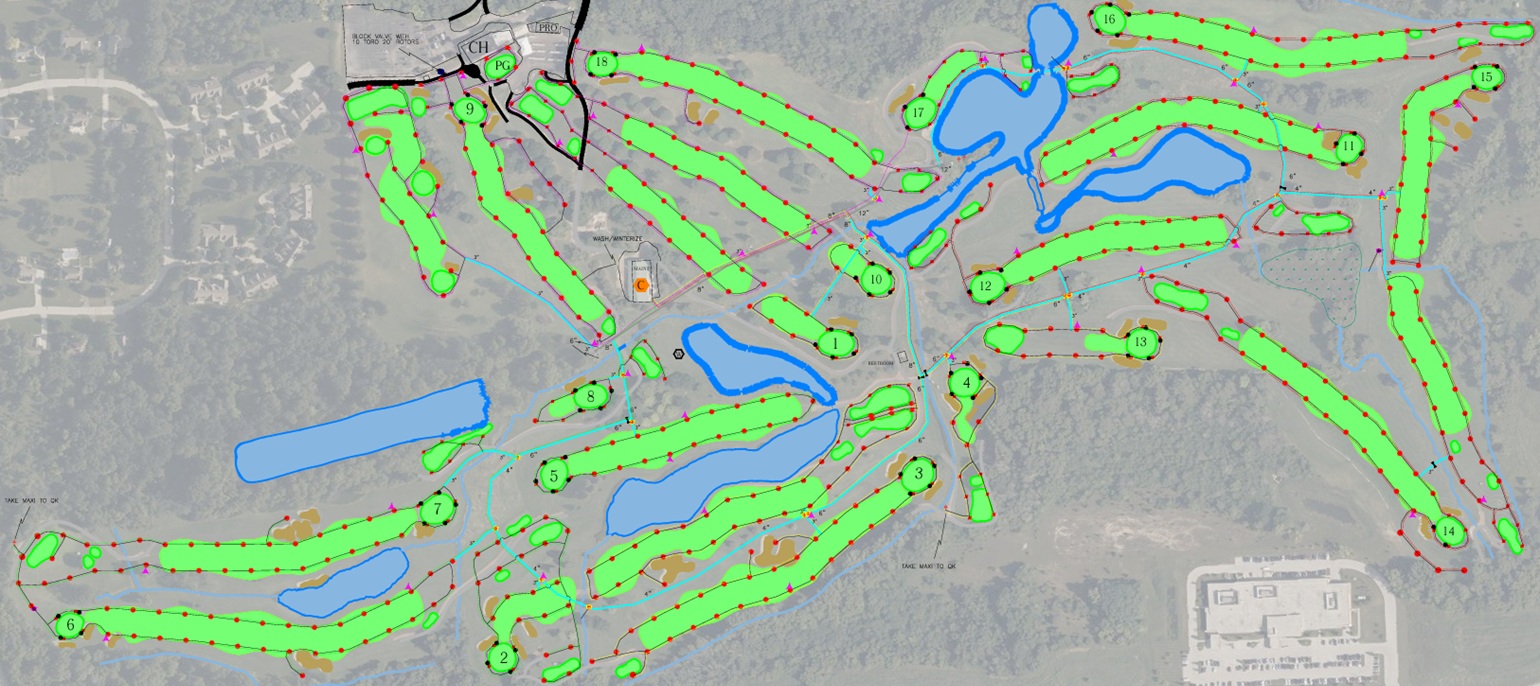
  • The new system will feature double row irrigation along both sides of all fairways, with additional spur lines into certain areas of the rough. This increased coverage will allow us to water up to 90% of the mowed turf on the golf course, reducing hard-pan areas and offering much more consistent playability.
  • Each sprinkler will be controlled independently. Currently, some sprinklers run together at the same time, creating issues when a sprinkler that waters a wetter area runs with one that waters a drier area. This results in setting sprinklers for the wet area, causing the dry area to be too dry, because having a wet area too wet is far more damaging to turfgrass. Individual control over each sprinkler means water can be adjusted with more precision, greatly reducing overly wet and dry spots and creating more consistent playing conditions.
  • Independent sprinklers for watering the greens and their surrounds. Most greens have only one set of heads around the green, so the surrounds receive water only when the green is watered. Because our goal is to keep the greens as dry as possible, the surrounds are not receiving the water they truly require. The new system will allow us to water the surrounds independently and create healthier, more consistent turfgrass in these areas.

Minimize water waste

As with most industries, technology and engineering have produced great improvements. This is no different for irrigation sprinklers and their control systems. New technology will allow for much more efficient watering.
  • New sprinklers have changed significantly over the last 30 years, particularly in efficiency and precision adjustments.
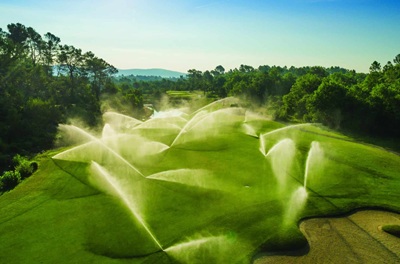
    • Greater efficiency. The uniformity of how a sprinkler distributes water now allows more water to go exactly where it is supposed to, providing better coverage with less waste.
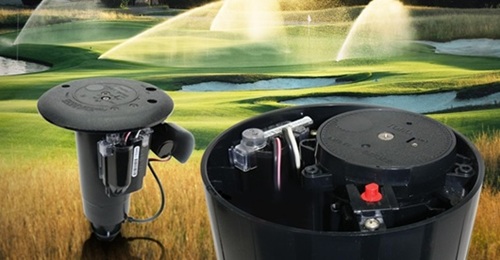
    • Sprinkler adjustment. Older sprinklers could only be adjusted, not manipulated. The only way to change an older sprinkler was to change nozzle sizes. This would change the water output (gallons per minute – GPM), which also changed how far the water was thrown (radius). Today’s sprinklers can be truly adjusted. Some of the many adjustments available now include: a much wider selection of nozzles and better GPM adjustment; the ability to fine-tune the radius independent of GPM; adjustments for the nozzle arc (how high or low the water comes out of the sprinkler), which is important if a sprinkler is on a hill or for windy sites; adjustments for how far the sprinkler rotates in a circle (full vs. part circle); and the ability to adjust how fast the sprinkler turns. All these adjustments add up to more precise and efficient watering, saving water and creating healthier turfgrass.
  • The control system for new sprinklers is far more precise now as well, with programming to the second instead of run times being rounded up to the minute. This is possible because the sprinkler's rotation speed has become much less random, allowing for better uniformity from sprinkler to sprinkler. A reduction of 30 seconds per head over the course of a season saves hundreds of thousands of gallons of water.
  • The new system is designed for today’s smartphone technology and includes built-in diagnostic tools to identify and fix issues before they become major problems. Being able to see if a particular sprinkler is not working will allow repair before the turfgrass gets stressed or burned out, translating into better conditions for play.

Reduced disruption for maintenance and repairs

The new irrigation system will be much more reliable, which means less interference to golfers from staff needing to dig holes for repairs in the middle of play areas.
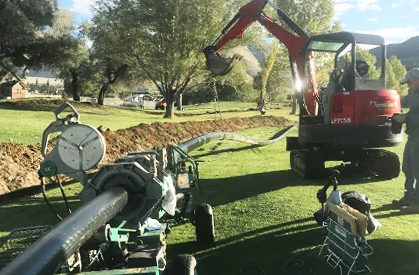
  • The new system will be installed with High-Density Polyethylene (HDPE) pipe. This pipe is made of plastic that is welded together, significantly reducing the number of glue connections. Glue joints are the most common areas to fail over time, creating leaks. Fewer leaks reduce the number of unsightly repairs associated with fixing them. HDPE pipe also has a much longer life expectancy.
  • The new system will have fewer components in fairways and approaches, resulting in less disruption when issues arise. The only components of the new system that will be laid out in fairways and approaches will be sprinkler heads. All valves and boxes will be installed in the rough, which will have less impact on players when finding the fairway.
  • The new sprinklers are designed with improved maintenance features for easier service. The components that require the most frequent replacement are now accessible without digging up the sprinkler. This eliminates issues with settling and sodding that frequently occur when sprinklers are dug up.